

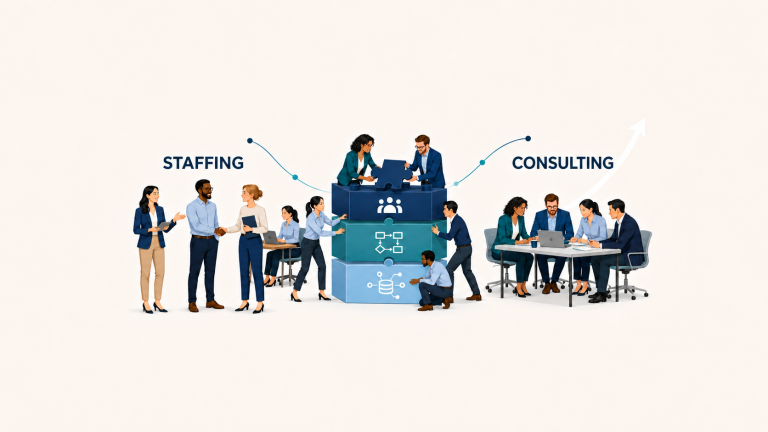
Winning consulting work is only the beginning. For staffing firms, the greater challenge is building an operating model that can deliver that work profitably and at scale.
Moving into consulting can create opportunities for growth, stronger client relationships, and higher margins. However, it also requires firms to build the right team, create repeatable processes, plan resources further in advance, and use technology that provides real-time visibility into project performance.
Mark Orttung, CEO of Projectworks, experienced this transition firsthand when he helped transform Nexient from a $30 million staffing firm into a software consultancy generating more than $140 million in revenue. Alongside Jenna Donohue, U.S. GTM Lead at Projectworks, he shared what staffing firms should understand before trying to scale consulting work.
Projectworks is a Bronze Sponsor of the 2026 TechServe Executive Summit, taking place November 9–11 in Huntington Beach, California.
“The planners are growing about 25% faster year over year,” Donohue said, referencing Projectworks customer data. “Their revenue per employee is 9% higher, and their utilization is over 8% higher.”
Those figures demonstrate how closely consulting growth is connected to operations. A firm may be able to win its first few projects without a mature operating model, but sustainable growth requires a foundation built specifically for consulting.
What separates consulting from staff augmentation?
The clearest distinction is who directs the work.
In a staff augmentation engagement, individuals typically receive their day-to-day direction from the client. In a consulting engagement, the consulting firm takes responsibility for managing its team and delivering an agreed-upon project or outcome.
“Is this one staff augmentation or is it consulting based on who is directing the work of our team members every week?” Orttung said, describing how Nexient evaluated its own projects.
That distinction affects nearly every part of the business. Consulting requires firms to define the work, manage project teams, monitor progress, forecast financial performance, and take greater responsibility for delivery.
It also requires leaders who can connect subject matter expertise with business development. Orttung found success by hiring consulting directors who were experienced practitioners but also comfortable selling. Bringing those experts into the sales process allowed Nexient to discuss client challenges, develop solutions, and establish credibility earlier in the relationship.
Existing recruiters can still support this model. Rather than replacing the recruiting team, firms can give recruiters clearer context about the professionals needed to build a lasting consulting practice, not just fill a single client opening.
What mistakes do firms make when moving from staffing to consulting?
One of the biggest mistakes is trying to scale a consulting model before proving that it works.
Firms may hire too many people, invest heavily in technology, or pursue several types of projects before establishing how they will sell, price, contract, staff, and deliver the work.
“The mistakes often come if you overhire before you’ve proven the motion or if you try to scale something that you haven’t really proven yet,” Orttung said.
A better approach is to begin with one or two project teams and create a complete, repeatable model around them. Firms should understand how work moves from the initial proposal through resource planning, delivery, invoicing, and payment. They can then apply what they learn from those early projects to improve future estimates and reduce risk.
This process also gives firms time to determine where they can stand out. Rather than trying to compete across every area, smaller firms should focus on a capability that is gaining market adoption but has not yet become dominated by global consultancies.
Donohue also highlighted the value of separating consulting from traditional staffing. Establishing distinct marketing, sales, delivery, and measurement processes can help clients understand the new offering while giving the firm room to test, measure, and refine its approach.
How do consulting margins compare with staff augmentation?
Consulting can generate stronger margins, but those margins depend on effective delivery.
At Nexient, Orttung said staffing engagements generally produced margins of approximately 20% to 30%. Consulting account margins began around 35% and eventually moved closer to 40% as the firm improved its delivery model, increased the value of its services, and raised its prices.
Those figures reflect Nexient’s experience rather than a guaranteed industry benchmark. Consulting firms assume risks that are not always present in staff augmentation. A delayed project start can leave an entire team on the bench, while poor scoping or unexpected delivery challenges can quickly reduce the profitability of an engagement.
Firms also need to monitor the difference between what was sold, delivered, billed, and ultimately paid. Each stage can affect the final margin. The goal is not simply to charge more for consulting work. It is to build the operational discipline needed to protect margins throughout the project.
When should a consulting firm move beyond spreadsheets?
Spreadsheets may be sufficient while a firm is testing its consulting model with a small team. According to Orttung, the need for a dedicated system often becomes more apparent when a consulting practice reaches approximately 10 to 20 people.
At that point, leaders need a consistent view of proposals, staffing needs, availability, utilization, project forecasts, time records, and invoices. An ATS may support recruiting, but it is generally built around job openings and candidates rather than projects and delivery.
“You really want a tool that’s in real time telling you you have a problem now so you have a chance to fix it,” Orttung said.
Without real-time visibility, firms may not discover a struggling project until weeks after the problem began. By then, the opportunity to protect the client relationship or recover the margin may have passed.
Technology should give leaders an up-to-date view of every project so they can intervene early. AI can build on that foundation by reducing administrative work, capturing lessons from previous engagements, and helping teams act on the information contained in their systems. However, AI cannot replace the need for a clear process and reliable operational data.
The path from staffing to consulting does not require firms to transform their entire business overnight. It requires them to start small, prove the model, learn from each engagement, and build the people, processes, and technology needed to scale with confidence.
Want to explore this topic further? Watch the full webinar here.