


Tech hiring demand and candidate experience are moving in opposite directions because growth is concentrated in specific industries, locations, titles, and skills, while candidates face intense competition, slow hiring processes, unclear opportunities, and rapidly changing AI requirements. For IT and engineering staffing firms, this disconnect creates an opportunity to guide clients toward real demand, improve screening, translate emerging skill needs, and rebuild candidate trust.
Dice, a Bronze Sponsor of the 2026 TechServe Executive Summit, analyzed job posting data from Lightcast, where Summit keynote speaker Ron Hetrick serves as Principal Economist, alongside survey responses from more than 1,100 U.S. tech professionals. The findings show that tech hiring is recovering, but the benefits are not reaching every industry, role, region, or candidate equally.
As Rachel McLaughlin, Content Strategy Manager at Dice, explained, “Demand is real. Candidate confidence is not catching up to it. And the gap—that’s exactly where staffing firms create the value.”
Where Is Tech Hiring Demand Growing Fastest?
U.S. tech job postings increased 15% year over year, and June 2026 marked the highest point in the two-year period analyzed. However, this is not an across-the-board hiring boom. Growth is concentrated outside many of the companies traditionally viewed as technology employers.
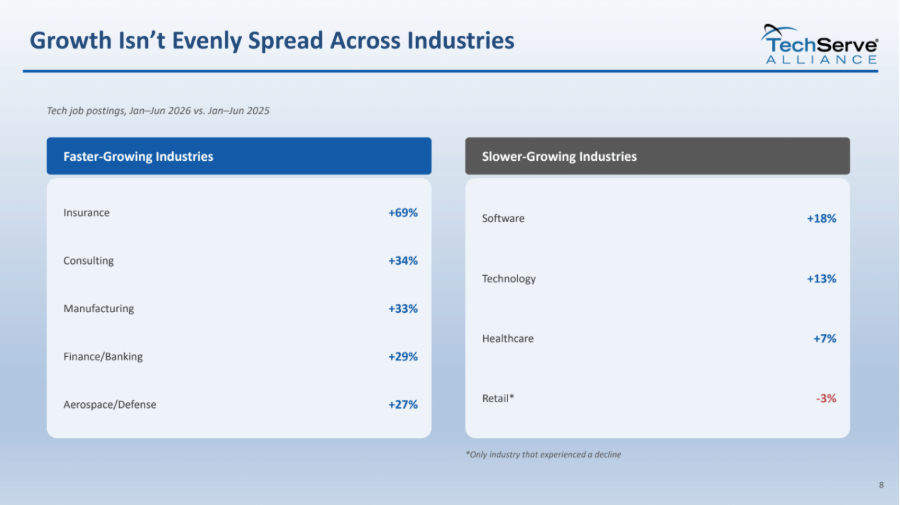
Insurance led the way with a 69% increase in tech postings, followed by consulting at 34%, manufacturing at 33%, finance and banking at 29%, and aerospace and defense at 27%. By comparison, software grew 18%, the technology industry grew 13%, healthcare increased 7%, and retail declined 3%.
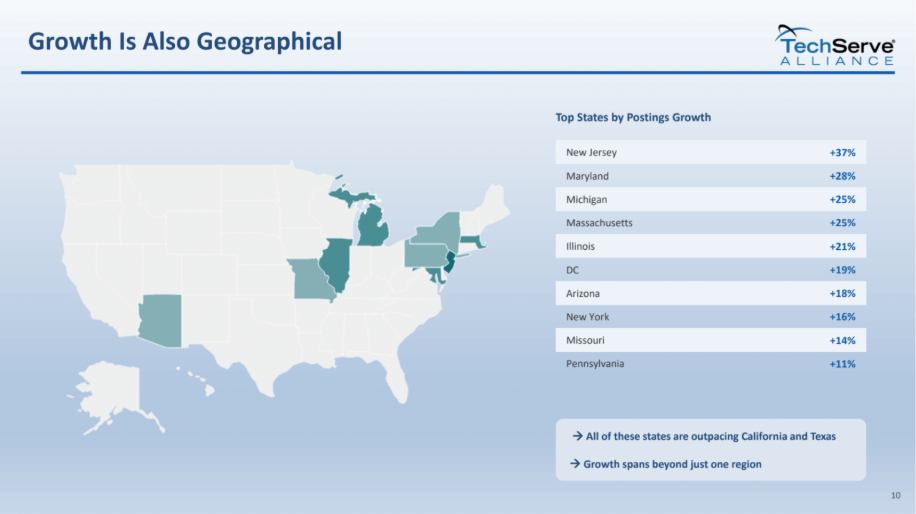
The geographic picture is also changing. New Jersey posted 37% growth, followed by Maryland at 28%, with Michigan and Massachusetts each at 25%. These states outpaced California and Texas, which remain major markets by total volume but are not leading current growth.
For staffing firms, that distinction matters. As Buddy Robinson, VP of Sales, Strategic/Enterprise Accounts at Dice, said, “Growth rate tells you where to expand. Volume tells you where revenue still lives.” Firms should not abandon high-volume roles or established technology clients, but they should rebalance business development toward industries and markets generating new demand.
Why Hasn’t Candidate Experience Improved?
Although postings are rising, only about one in seven tech professionals feels positive about the market. 40% said companies appear to be hiring, but real opportunities are not materializing, while 37% said it is harder than ever to stand out.
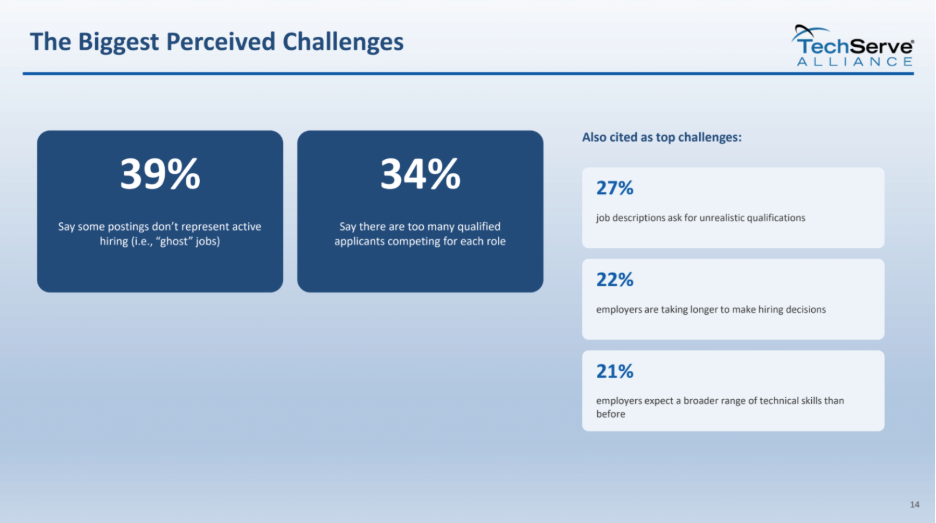
Candidates identified several reasons for that frustration: 39% believe some postings do not represent active hiring, 34% said too many qualified applicants are competing for each role, 27% cited unrealistic qualifications, and 22% pointed to slower employer decisions.
AI-driven screening is widening the trust gap. Ninety-two percent of surveyed tech professionals believe AI screening misses qualified candidates, while 78% feel pressure to exaggerate their qualifications to get noticed. Sixty-five percent have altered their resumes specifically to appeal to AI tools.
This gives IT and engineering staffing firms a clear way to differentiate. “Trust isn’t a soft benefit anymore,” Robinson said. “It’s the real reason a staffing firm still exists in a market full of AI screening tools.” Human recruiters can identify transferable experience, explain client expectations, and recognize strong candidates whose resumes do not perfectly mirror a job description.
How Are AI Skills Redefining What “Qualified” Means?
AI fluency is quickly becoming a baseline expectation. In mid-2023, approximately 15% of U.S. tech postings required AI skills. By mid-2026, that figure had reached 75%. Among surveyed professionals, 86% said AI-related skills appear more often in the roles they are pursuing than they did one year ago.
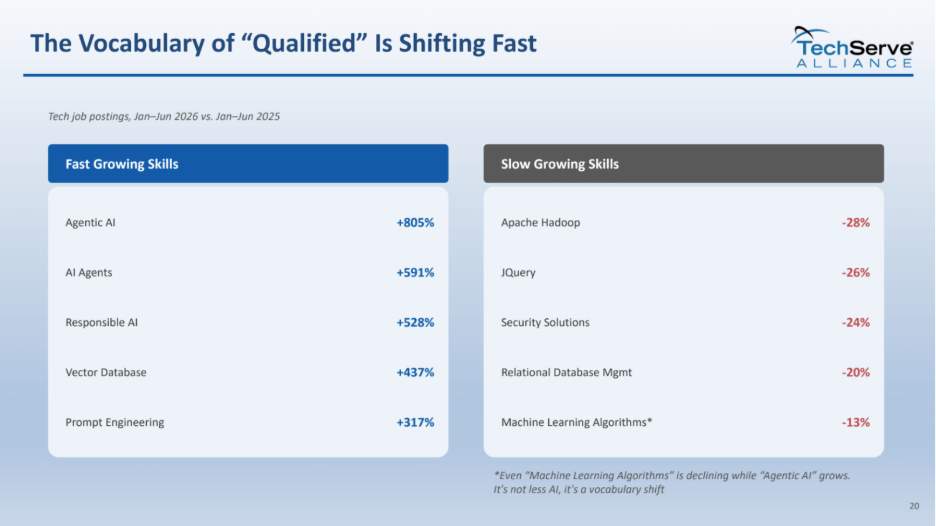
The language is changing just as quickly as the demand. Over a six-month period, postings mentioning agentic AI increased 805%, AI agents rose 591%, responsible AI grew 528%, vector databases increased 437%, and prompt engineering rose 317%. Meanwhile, machine learning algorithms declined 13% as a listed skill.
“That’s not less AI being asked for,” McLaughlin said. “It’s the same underlying capability described in a completely different vocabulary.”
This shift extends beyond explicitly AI-focused positions. Radar systems engineers, structural engineers, and directors of data center operations were among the fastest-growing titles, reflecting increased demand for the infrastructure supporting AI deployment. Enterprise integration, LangChain, and observability also recorded significant growth.
For recruiters, static search terms can quickly become a competitive disadvantage. “Qualified isn’t a fixed bar anymore,” McLaughlin said. “It’s a moving target.” Staffing firms should regularly update sourcing language, help candidates translate relevant experience into current terminology, and work with clients to distinguish essential capabilities from trendy keywords.
How Can IT and Engineering Staffing Firms Bridge the Disconnect?
The data points to four immediate actions:
- Rebalance business development. Pursue growing industries such as insurance, consulting, manufacturing, finance, and defense while maintaining high-volume technology accounts.
- Modernize sourcing and screening. Update searches to reflect emerging AI vocabulary and keep human judgment involved when evaluating candidates.
- Coach both sides of the hiring process. Help candidates describe their skills accurately while encouraging clients to clarify requirements, shorten decision timelines, and communicate whether positions are actively funded.
- Watch for deployment signals. Growth in enterprise integration, observability, data centers, and related infrastructure can indicate that AI investment is moving from experimentation into implementation.
As Robinson summarized, “The market shifted. It’s not stopped. AI fluency is table stakes. Trust is the differentiator.” The firms best positioned to grow will be those that can explain exactly which industries, markets, roles, and skills are creating demand—and then deliver a candidate experience grounded in clarity and human expertise.
Interested in hearing the full conversation? Watch the webinar here.