

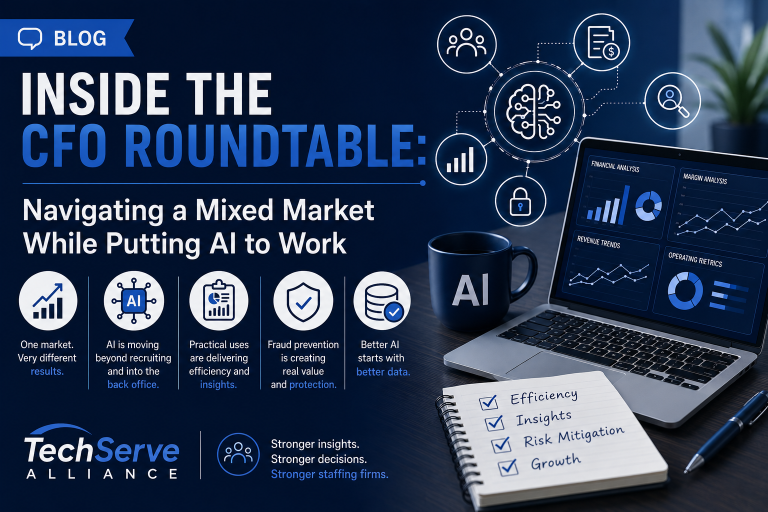
The latest TechServe CFO Roundtable reflected an IT staffing market that remains anything but uniform.
Some firms are still working through revenue declines and the loss of major accounts, while others are reporting double-digit growth. Direct hire is strengthening in some segments, contract staffing is driving growth for others, and long-standing client relationships continue to be an important source of stability.
Against that backdrop, another topic dominated the conversation: AI is quickly moving beyond recruiting and into the back office.
CFOs shared real-world examples of using AI for financial analysis, payroll reconciliation, CRM activity, HR support, candidate screening and fraud detection. While many are still working to quantify the return, the discussion showed that AI is increasingly becoming part of the operating infrastructure of staffing firms.
One Market, Very Different Results
There was no single story on business performance.
Roundtable participants reported results ranging from revenue declines approaching 20% to growth of 40% in portions of their businesses. Some firms remain cautious about the remainder of the year, while others are seeing significant momentum from contract staffing, new client wins and expansion within existing accounts.
One particularly interesting theme was where growth is coming from.
For some firms, the strongest results aren’t coming from aggressive new-client acquisition but from expanding relationships with existing customers. Long-tenured business development leaders and deep client relationships were also cited as important contributors to maintaining revenue through a difficult market.
Contract staffing remains a significant growth engine, but direct hire is also showing strength in several businesses. Healthcare permanent placement was highlighted as an area of opportunity even as travel nursing remains softer, while other firms reported substantial increases in direct-hire revenue that helped improve overall profitability.
The larger takeaway: the market remains challenging, but opportunity is highly dependent on client mix, service mix and the strength of existing relationships.
CFOs Are Finding Practical Uses for AI
The AI conversation revealed a noticeable shift from “What can AI do?” to “Where can it eliminate work?”
Finance leaders described using AI to analyze profitability, interrogate financial data, update dashboards, perform budget-to-actual and margin analysis, and turn complex financial information into insights that can be more easily communicated across the organization.
In one example, work that previously required hours of pulling and preparing profitability data could be completed in minutes. Another use case involved automating payroll reconciliation through repeatable multi-step processes, significantly reducing administrative time.
The applications extended beyond finance.
Participants discussed AI integrations that summarize sales calls, create client reminders and capture CRM activity; HR agents that answer routine policy questions; and recruiting tools that conduct initial interviews, perform technical checks and help detect candidate fraud.
The common denominator is straightforward: remove repetitive work while getting useful information to employees faster.
AI ROI Is Still a Work in Progress
For CFOs, however, efficiency alone isn’t enough. Eventually, the investment has to show a return.
That remains one of the biggest unanswered questions.
Some firms are grouping AI-related expenses together so they can better compare investment with resulting hires and revenue. Others are establishing clear performance expectations, using shorter contracts and eliminating tools that don’t demonstrate value within a reasonable timeframe.
Participants generally acknowledged that many AI investments are still too new to judge solely on revenue contribution. One expectation discussed was a three-to-six-month window before benefits become more visible through metrics such as faster candidate submissions and increased recruiting efficiency. Others expect clearer financial impact next year after the initial investment in implementation, adoption and data cleanup.
That suggests a more useful AI ROI equation may initially include more than direct revenue:
Time saved + capacity created + speed improved + costs eliminated + revenue generated.
For CFOs evaluating AI investments today, all five may matter.
Candidate Fraud Is Accelerating the Business Case
One area where the value proposition is becoming particularly clear is candidate fraud.
Participants described using multiple AI-enabled tools to examine candidate identities, interviews, digital profiles and other indicators for signs of potential fraud. In one instance, technology helped uncover a completely fabricated candidate. Other tools are being used to identify candidates potentially relying on AI during the interview process.
The irony wasn’t lost on the group: AI is increasingly necessary to combat problems that AI itself is helping create.
For staffing firms, this makes fraud prevention more than a recruiting issue. Poor candidate validation creates financial, reputational and client risk, giving CFOs a direct stake in improving the process.
Better AI Starts With Better Data
Another important lesson emerged from the discussion: firms can’t simply layer AI on top of years of inconsistent data and expect strong results.
Database cleanup, duplicate removal and profile enhancement are becoming part of AI readiness. One firm described reallocating spending away from job boards and toward AI and sourcing technology after examining where successful candidates were actually coming from.
AI is forcing firms to confront an issue that has existed for years: the quality of the output depends heavily on the quality of the underlying information.
Interestingly, implementing AI can expose weaknesses beyond the database. One HR AI project uncovered outdated policies and documentation during implementation, prompting the company to improve the source material before relying on the agent to answer employee questions.
In that sense, preparing for AI can itself become an operational improvement exercise.
The Technology May Be Easier Than the Culture
Several participants pointed to another barrier that has little to do with technology: employee adoption.
Recruiters and other employees have sometimes been reluctant to embrace AI, particularly when they perceive automation as a potential threat. Firms that have gained traction have focused on demonstrating how AI removes tedious work rather than replaces the employee.
In at least one case, initial recruiter resistance declined after employees experienced how much front-end screening work the technology eliminated.
That may be one of the most important implementation lessons for leadership teams.
Buying the technology is the easy part. Changing behavior is the harder part.
Employees need to trust the output, understand the benefit and see how the technology improves their own performance. Human validation also remains important; several participants continue to double-check AI-generated results rather than treating them as automatically correct.
Efficiency Matters More in an Uneven Market
The roundtable ultimately connected two issues that may initially seem separate.
The staffing market remains difficult to predict. Some firms are growing rapidly while others continue to manage declines. Client relationships, contract mix, direct-hire opportunities and individual account wins can dramatically change the trajectory of a business.
At the same time, firms are being asked to operate more efficiently.
That makes AI particularly relevant—not because every new tool deserves investment, but because technology that meaningfully reduces administrative work, accelerates recruiting, improves decision-making or protects against fraud can create capacity without requiring proportional increases in headcount.
For CFOs, the challenge now is moving beyond the novelty of AI and applying the same discipline they would to any other investment:
What problem are we solving? What does it cost? What measurable outcome do we expect? How long are we willing to wait for that outcome—and what will we stop doing if it doesn’t deliver?
Those questions may ultimately separate AI experimentation from AI that creates meaningful business value.
Interested in learning more about the roundtables TechServe has to offer? Click here.