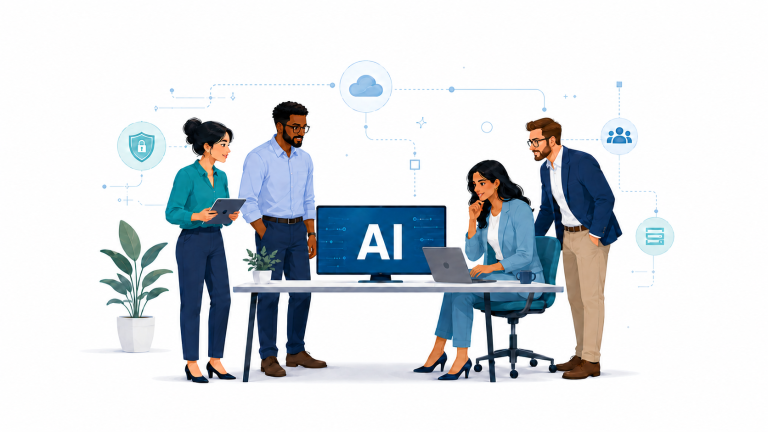


In staffing and recruiting, technology continues to evolve at a rapid pace. From AI-powered research tools to automated outreach and note-taking, sales teams have more resources at their disposal than ever before. Yet one truth remains constant: relationships still drive results.
That theme was front and center during a breakout session at the 2025 TechServe Alliance Executive Summit, where industry leaders explored how relationship-driven sales can — and must — coexist with emerging AI tools. While the conversation acknowledged the growing role of technology, it repeatedly returned to a foundational idea: trust, credibility, and human connection remain the cornerstones of successful sales.
As Megan McCann, CEO & Founder at McCann Partners, put it simply, “People matter. That’s really the name of the game. People buy from people they like.” While AI may change how sales teams operate, it does not change why buyers say yes.
The challenge for today’s sales leaders is not choosing between old school and new school, but learning how to blend both in a way that strengthens trust rather than erodes it.
The Fundamentals of Relationship-Driven Sales Haven’t Changed
At its core, relationship-driven sales is about showing up authentically, consistently, and with genuine curiosity. It’s about understanding what matters to clients beyond the transaction itself.
McCann emphasized that while tools and processes will continue to evolve, the human element cannot be automated away. “We may use tools and iterations to do things differently,” she said, “but at the end of the day, I still want to sit across from someone and engage with them.”
The Power of the “Micro” in Building Trust
For Brad Rosen, Founder at Stride Path Partners, the differentiator has always lived in the details. “It’s about the micro,” Rosen explained. “The little things still go the furthest, and they’re what make the difference in relationships.”
Those micro-moments include handwritten notes, remembering personal milestones, and following up in ways that feel thoughtful rather than transactional. “I personalize everything,” Rosen added. “Remembering someone’s kid’s soccer game or what’s important to them — that’s what builds real relationships.”
Face-to-Face Still Accelerates Relationships
Despite the rise of virtual selling, in-person interaction remains the fastest way to build trust. Connor Cardew, Vice President of Sales at Digital Prospectors Corp, underscored that point. “Face-to-face is still always going to be king,” Cardew said. “The speed at which it helps develop trust and build relationships just can’t be replicated.”
AI’s Role: Automating the Mundane, Elevating the Human
Where AI truly shines is in supporting salespeople behind the scenes. McCann described how her highest-performing sellers use AI tools to enhance, not replace, their relationship-building efforts. “She’s not having the tools do the work for her,” McCann noted. “They augment the work she’s already doing, and that’s really important.”
Chris Mader, Founder & CEO at MTA Consultancy, highlighted why this matters so much for sales organizations. “A lot of great salespeople are not great at documentation,” Mader said. “We’re crazy not to leverage AI note-taking, because it creates consistency and makes that information usable.”
Coaching, Metrics, and the Leadership Lens
From a leadership perspective, AI also opens new opportunities for coaching and development. Mader emphasized that while tools can accelerate learning, leaders still need to be clear about expectations. “Meetings are still the number one leading indicator,” he explained. “Whether they’re in person or virtual, relationships are built through conversations.”
Blending Generations and Strengths
One of the most powerful themes to emerge is the opportunity to blend generational strengths. Younger sellers often bring comfort with technology and experimentation, while more experienced professionals excel at relationship-building and intuition.
“The people who are going to win are the ones who adopt AI tools but also learn from the old-school relationship builders,” Cardew said. “Everybody can learn from each other.”
The Path Forward
AI will continue to reshape sales in staffing and recruiting. New tools will emerge, processes will change, and expectations will evolve. What won’t change is the importance of trust, credibility, and human connection. By blending relationship-driven principles with thoughtful use of AI, sales and staffing professionals can strengthen client trust, improve efficiency, and remain competitive in a rapidly changing landscape. As technology continues to evolve, those who successfully integrate innovation with humanity will be best positioned for long-term success.
As Rosen noted, “AI is helping automation and speed, but it doesn’t replace the personal touch. You still have to earn trust, and that takes time.”
Firms that get this balance right will not only keep pace with change — they’ll build stronger, more resilient client partnerships in the process.
Key Takeaways for Sales and Staffing Leaders
Throughout the discussion, a consistent message emerged: success lies in balance. Professionals should remain adaptable, meet clients where they are, and embrace change without abandoning what has always worked.
Key takeaways include:
- Prioritize authenticity in every interaction
- Use AI to support efficiency, not replace connection
- Encourage face-to-face engagement whenever possible
- Foster mentorship across generations
- Balance technological innovation with human insight