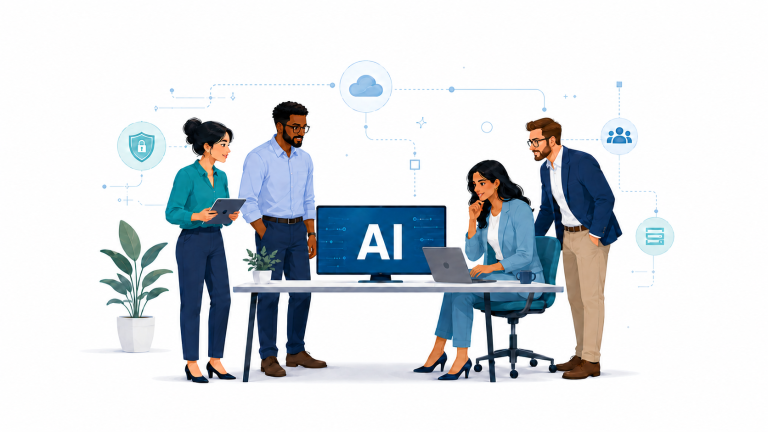


The next generation of recruiters won’t be defined by how many calls they make or resumes they screen. Instead, they’ll be defined by how effectively they combine human judgment with intelligent automation to build trust, relationships, and outcomes at scale.
As artificial intelligence continues to mature across the staffing industry, one message is becoming increasingly clear: AI is not replacing recruiters. It is elevating the role.
Rather than eliminating human involvement, AI is taking on the repetitive, time-consuming work that has long limited recruiter capacity. This shift is allowing recruiters to operate at a higher level—more strategic, more consultative, and more focused on what humans do best.
Moving Past the AI Hype
Much of the conversation around AI has been dominated by hype, creating unrealistic expectations about what the technology can and cannot do. The reality, however, is far more grounded.
Andy Jones, CEO of TrackerRMS, emphasized that AI should be viewed as an enabler, not a cure-all. “It’s not a silver bullet,” Jones explained. “It’s a tool and an enabler. You still have to start with the business problem and then apply process and technology to solve it.”
Staffing firms are realizing that AI works best when it addresses existing challenges—high volume, limited recruiter time, and administrative burden—rather than attempting to reinvent the recruiting function altogether. The firms seeing success are the ones using AI to remove friction, not replace judgment.
AI as a Recruiting Colleague
One of the most meaningful shifts underway is how recruiters interact with AI day to day. Instead of acting as a passive tool that requires constant prompting, AI is increasingly functioning as an autonomous colleague—working across channels, following up with candidates, and surfacing insights without direct supervision.
Aaron Wang, CEO of Alex.AI, described this distinction as the difference between passive and active work. AI, he noted, can continue screening, following up, and preparing insights even when recruiters are offline, allowing humans to focus their time on higher-value conversations.
This model gives recruiters leverage. Instead of juggling dozens of administrative tasks, they step into conversations better prepared, with more context and clearer priorities. Recruiters aren’t working less—they’re working smarter.
Where AI Excels—and Where Humans Still Matter Most
AI is already proving effective at handling structured, repeatable tasks. Resume analysis, skills matching, interview summaries, and initial candidate screening are areas where automation consistently delivers value.
Marcelo Amiano, Co-Founder and CEO of NewCombin, noted that this shift allows recruiters to focus their energy where it matters most. “Everything that is repetitive will be done by AI,” Amiano said, “and it will put that information on the table for the human side to decide.”
That final decision remains firmly human. Understanding motivation, culture, nuance, and intent—especially when candidates don’t explicitly articulate those factors—still requires human judgment. While AI can provide data and recommendations, recruiters remain responsible for interpretation and trust-building.
Jones reinforced this balance, warning against over-automation. If every firm relied entirely on AI, he argued, differentiation would disappear. Relationships, trust, and human connection are what ultimately set firms apart.
Improving the Candidate Experience
Concerns about how candidates would react to AI-driven screening have also proven largely unfounded. Many candidates now expect fast, flexible, and always-on engagement—and automation enables exactly that.
AI allows candidates to engage on their own schedule, receive quicker responses, and avoid being ghosted. Early-stage screening can happen immediately rather than days later, creating a smoother and more respectful experience.
Still, panelists agreed that AI should open the door, not replace human interaction entirely. As the process advances, recruiter involvement becomes increasingly important to ensure alignment, transparency, and trust.
Redefining the Recruiter Role
As AI becomes more deeply embedded in recruiting workflows, the recruiter’s role is evolving. Rather than spending most of their time on coordination and administration, recruiters are becoming managers of AI agents and advisors to clients and candidates.
Wang described this evolution as both inevitable and positive. Recruiters, he explained, did not enter the profession to reschedule interviews or sift through resumes. With AI handling that work, recruiters can spend more time building relationships, advising hiring managers, and engaging top talent.
This shift may also accelerate development for newer recruiters. With better data and automation support, junior recruiters can ramp faster and operate more effectively earlier in their careers.
Key Takeaways for the Next-Gen Recruiter
- AI is not replacing recruiters—it is elevating the role
- Repetitive, administrative tasks are increasingly automated
- Recruiters are becoming strategic advisors and relationship builders
- Human judgment remains critical for motivation, culture, and final decisions
- Candidates benefit from faster, more responsive engagement
- The future recruiter manages AI agents, not just requisitions
AI is reshaping recruiting, but not by removing the human element. Instead, it is amplifying what great recruiters already do best. For staffing leaders who adopt intentionally, the next generation of recruiting will be more strategic, more human, and more impactful than ever.
TechServe members can watch the webinar replay here.